How to Adjust Chair Seat Pan Depth for Leg Comfort?
Have you ever sat in a chair and felt a nagging pressure behind your knees? Maybe your legs go numb after an hour, or your lower back aches by the end of the day. The problem might not be your posture. It could be your seat pan depth.
Seat pan depth is the distance from the front edge of your chair seat to the backrest. If this measurement is off, your body pays the price. A seat that is too deep pushes into the back of your knees and cuts off blood flow. A seat that is too shallow leaves your thighs unsupported and puts extra stress on your lower back.
Millions of office workers sit for eight or more hours every day. Yet most people never adjust their seat pan depth. They adjust the height, tilt the backrest, and move on. This single overlooked adjustment can be the difference between a comfortable workday and chronic leg discomfort.
This guide walks you through everything you need to know. You will learn what seat pan depth is, why it matters, and exactly how to adjust it on your chair. You will also find solutions for chairs that lack a built-in adjustment feature.
Key Takeaways
- Seat pan depth refers to the horizontal distance from the front edge of the seat to the backrest, and it directly affects leg circulation, posture, and comfort during prolonged sitting.
- The ideal seat pan depth leaves a two to four finger gap (roughly two to three inches) between the front edge of the seat and the back of your knees, allowing proper blood flow and thigh support.
- Incorrect seat pan depth is a leading cause of numbness, tingling, knee pressure, and lower back pain for people who sit for extended periods at work or home.
- Most modern ergonomic office chairs include a seat slide mechanism or a seat depth adjustment lever, usually located under the front of the seat pan, that lets you move the seat forward or backward.
- If your chair does not have a built-in seat pan depth adjustment, you can use a lumbar support cushion or a seat pad to effectively reduce the depth and bring the backrest closer to your body.
- Adjusting seat pan depth works best as part of a full ergonomic setup, including correct seat height, backrest angle, armrest position, and monitor placement for total body comfort.
What Is Seat Pan Depth and Why Does It Matter?
Seat pan depth is a specific measurement of your chair. It describes the flat sitting surface from front to back. More precisely, it is the distance from the front edge of the seat to the point where the backrest begins.
This measurement matters because it determines how much of your thigh the seat supports. The human thigh needs adequate support to maintain good posture and healthy circulation. When the seat pan is the correct depth, your body weight distributes evenly across your thighs and buttocks.
Research in ergonomics shows that improper seat depth is one of the top three causes of sitting discomfort in office environments. The American National Standards Institute (ANSI) and the Human Factors and Ergonomics Society (HFES) include seat pan depth as a critical dimension in their office chair guidelines.
A seat pan that is too deep forces you to either slouch forward or scoot to the edge of the chair. Both positions remove lumbar support from your lower back. A seat pan that is too shallow creates a feeling of instability and places concentrated pressure on a smaller area of your thighs.
The ideal seat pan depth varies by person because leg length differs from individual to individual. This is why adjustability is so important. A chair that fits a person who is 6 feet tall will not fit someone who is 5 feet 4 inches tall. Understanding this basic concept is the first step toward fixing your leg comfort.
Signs Your Seat Pan Depth Is Wrong
Your body sends clear signals when the seat pan depth is incorrect. Learning to recognize these signs helps you act before discomfort becomes a chronic issue.
Numbness or tingling in your legs is the most common symptom of a seat that is too deep. The front edge of the seat compresses the area behind your knees. This pressure restricts blood flow through the popliteal artery and compresses the nerves running behind the knee joint. Over time, you feel pins and needles in your calves and feet.
If you constantly feel like you are sliding forward in your chair, the seat is likely too deep for your body. You cannot maintain contact with the backrest without your knees hitting the seat edge. This creates a cycle of fidgeting and repositioning that disrupts focus and productivity.
On the other hand, a seat pan that is too shallow causes aching in your sit bones. Without enough surface area to distribute your weight, pressure concentrates on a small part of your buttocks. You may also feel your hamstrings straining because your thighs lack support.
Another telltale sign is lower back pain that appears only while sitting. When you scoot forward to avoid knee pressure, you lose contact with the lumbar support. Your spine rounds, your muscles fatigue, and pain follows.
Pay attention to how often you shift in your seat. Frequent position changes every few minutes suggest that your seat pan depth needs adjustment. A well-fitted chair allows you to sit comfortably for 30 minutes or more before needing to move.
How to Measure Your Ideal Seat Pan Depth
Before you touch any levers, you need to know your ideal measurement. This step takes less than two minutes and requires only a measuring tape or a ruler.
Sit on a firm, flat surface with your back against the wall. Keep your feet flat on the floor with your knees bent at a 90 degree angle. Now measure the distance from the wall (representing the backrest) to the back of your knee crease. Write this number down.
Subtract two to three inches from that measurement. This gives you your ideal seat pan depth. The subtracted inches create the critical gap between the seat edge and the back of your knees. This gap protects your blood vessels and nerves from compression.
For most adults, the ideal seat pan depth falls between 15 and 18 inches. People with shorter legs typically need 15 to 16 inches. People with longer legs need 17 to 18 inches or more.
You can also do a quick check while sitting in your chair. Sit all the way back so your lower back touches the lumbar support. Make a fist and try to fit it between the front edge of the seat and the back of your knee. If your fist fits with a little room, the depth is close to correct.
If the seat edge presses firmly into the back of your knees, the seat is too deep. If you can fit much more than a fist, the seat may be too shallow. This fist test is the fastest way to evaluate seat pan depth without any tools.
How to Adjust the Seat Pan Depth on an Adjustable Chair
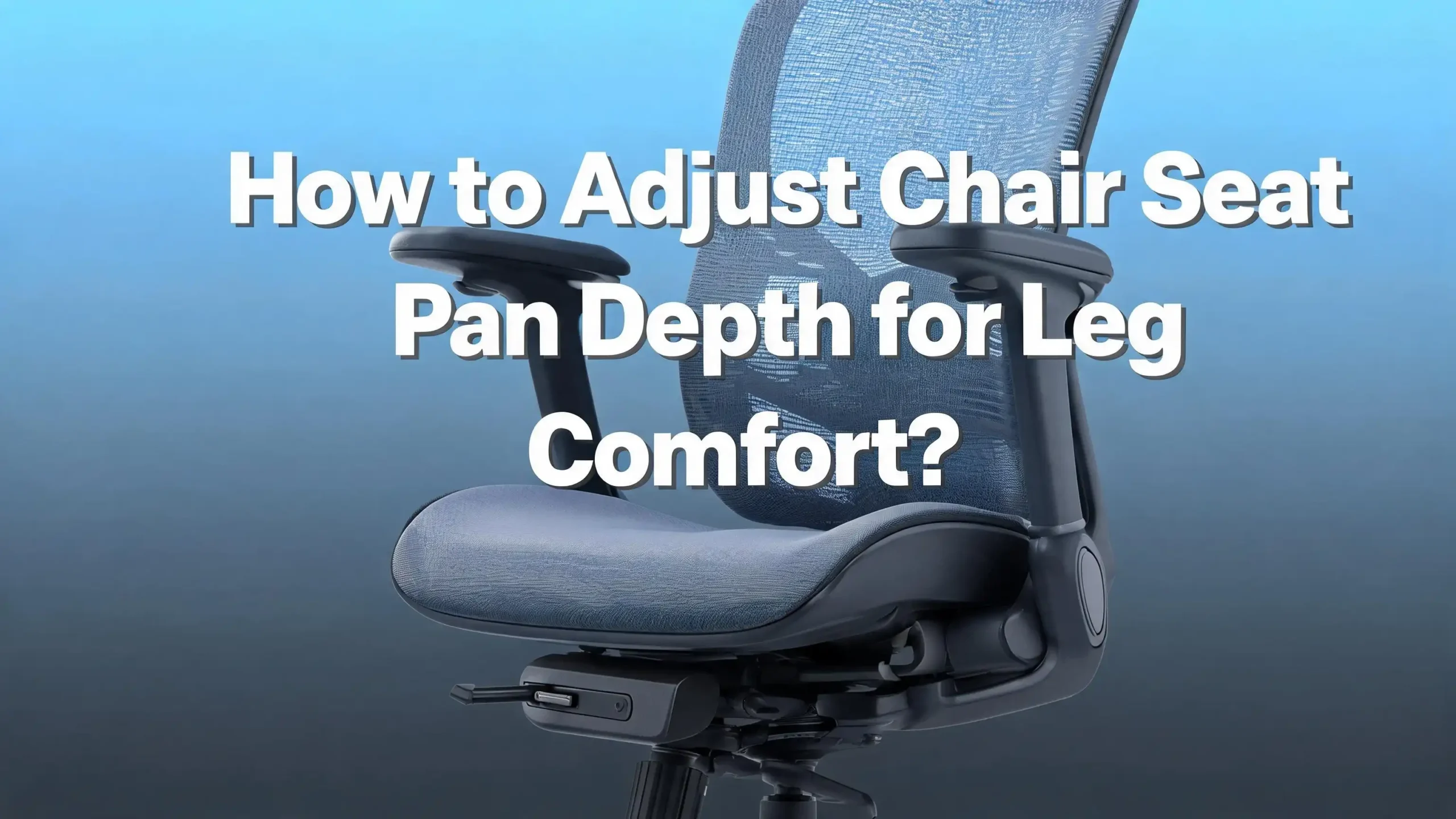
Many modern ergonomic chairs come with a seat slide feature. This mechanism lets you move the seat pan forward or backward while keeping the backrest in place.
First, locate the seat depth adjustment control. On most chairs, this is a lever or button under the front edge of the seat, separate from the height adjustment lever. Some chairs use a paddle that you push left or right. Others have a knob that you twist. Check your chair’s manual if you cannot find it.
Next, sit in the chair with your back pressed against the lumbar support. Place your feet flat on the floor with your knees at roughly 90 degrees. This is your baseline position.
Now activate the adjustment mechanism. While holding the lever or pressing the button, slide the seat pan forward or backward until you achieve that two to four finger gap behind your knees. Release the lever to lock the seat in place.
Stand up and sit back down to test the new position. Check that your lower back still makes good contact with the lumbar support. Verify that your thighs rest comfortably on the seat without the edge pressing into your knees.
Some chairs offer incremental adjustments in half-inch steps. Others allow a continuous slide. Either way, small changes make a big difference. Move the seat pan in small increments and test each position before making further adjustments. The goal is support across at least two thirds of your thigh length while maintaining that protective gap at the knee.
What to Do If Your Chair Lacks Seat Depth Adjustment
Not every chair has a seat slide feature. Budget office chairs and older models often have a fixed seat pan. You still have options to improve your comfort without buying a new chair.
The simplest solution is to add a lumbar support cushion to your backrest. A cushion that is three to four inches thick effectively pushes your body forward on the seat. This reduces the functional depth of the seat pan and moves the seat edge away from the back of your knees.
Another option is a seat cushion with a slightly shorter depth than your current seat. Place it on top of your chair seat. Choose one that ends a few inches before the front edge of the seat pan. This shortens the effective sitting surface and creates the gap your knees need.
You can also try placing a rolled-up towel behind your lower back. This is a quick, cost-free fix that mimics the effect of a lumbar cushion. Adjust the thickness of the roll until you feel comfortable support without excessive forward push.
If your chair has a removable seat pad, check whether the manufacturer offers seat pans in different sizes. Some modular office chairs allow you to swap seat pans for shorter or longer versions.
Finally, consider your sitting position. Tilting the seat pan slightly forward (if the chair allows tilt adjustment) can shift your weight distribution and reduce pressure at the knee. A forward tilt of five degrees changes the contact pattern between your thighs and the seat and can relieve discomfort even on a fixed-depth chair.
The Two-Finger and Four-Finger Rule Explained
Ergonomics professionals use a simple guideline called the two to four finger rule to check seat pan depth. This rule provides a quick, reliable benchmark for proper fit.
Here is how it works. Sit fully back in your chair so your lumbar spine contacts the backrest. Then place your fingers horizontally between the front edge of the seat and the crease behind your knee. You should be able to fit two to four fingers in that gap.
Two fingers represent roughly one and a half inches. Four fingers represent about three inches. Anywhere in this range provides a good balance of thigh support and knee clearance.
If you can fit fewer than two fingers, the seat pan is too deep. The edge is pressing into the soft tissue behind your knee. This restricts venous return and puts pressure on the peroneal nerve. Over hours of sitting, this causes numbness, swelling, and discomfort.
If you can fit more than four fingers, the seat pan is too shallow. Your thighs are hanging off the edge without adequate support. This concentrates pressure on your sit bones and can lead to tailbone pain and hamstring fatigue.
The beauty of this rule is its simplicity and portability. You do not need any tools. You can check your seat pan depth at any desk, in any chair, at any time. Make it a habit to do this check whenever you sit in a new chair or adjust your workstation. It takes five seconds and can save you hours of discomfort.
How Seat Pan Depth Affects Blood Circulation in Your Legs
Blood circulation in the lower body depends on unobstructed flow through the arteries and veins behind the knee. The popliteal artery and vein pass directly through the back of the knee joint. When a hard seat edge compresses this area, circulation slows down.
Reduced blood flow causes the familiar sensation of legs “falling asleep.” Your tissues receive less oxygen. Metabolic waste products build up in the muscles. You feel tingling, then numbness, then pain if you do not shift your position.
Studies in occupational health show that prolonged compression at the back of the knee increases the risk of deep vein thrombosis (DVT) in people who sit for long periods. DVT is a serious condition where blood clots form in the deep veins of the leg.
Proper seat pan depth removes this compression entirely. When your seat ends two to three inches before your knee crease, the blood vessels and nerves pass through an open space. Blood flows freely. Nerve signals travel without interference.
The effect is immediate. People who correct their seat pan depth often report that their legs feel lighter and more energetic within the first day. The constant background discomfort they had normalized simply disappears.
For additional circulation support, combine proper seat pan depth with regular movement breaks. Stand up every 30 to 60 minutes. Walk for a minute or two. This combination of correct seat geometry and movement keeps your legs healthy throughout long work sessions.
The Connection Between Seat Pan Depth and Lower Back Pain
Your seat pan depth has a direct impact on your lumbar spine health. This connection is often overlooked, but it is critical.
When the seat pan is too deep, you face a dilemma. You can sit all the way back and let the seat edge cut into your knees. Or you can scoot forward, relieve the knee pressure, and lose all lumbar support. Most people choose the second option without realizing it.
Sitting without lumbar support causes your pelvis to tilt backward. Your lower spine rounds into a C-shape called posterior pelvic tilt. The natural inward curve of your lumbar spine flattens. The muscles, ligaments, and discs in your lower back absorb loads they were not designed to handle.
Over weeks and months, this leads to muscle fatigue, disc compression, and chronic lower back pain. Physical therapists see this pattern frequently in office workers who sit in poorly fitted chairs.
Correcting seat pan depth restores the chain of support. When you can sit all the way back without knee discomfort, your lumbar spine contacts the backrest. The backrest holds your pelvis in a neutral position. Your spine maintains its natural curves. Your back muscles work less because the chair shares the load.
A 2019 study published in the journal Applied Ergonomics found that seat depth adjustment was one of the most significant chair features for reducing self-reported lower back discomfort. Participants who used chairs with adjustable seat pans reported less pain and greater satisfaction than those with fixed-depth seats.
Step-by-Step Guide to a Full Ergonomic Chair Setup
Seat pan depth adjustment works best as part of a complete ergonomic setup. Here is a clear sequence to follow every time you sit down at your workstation.
Start with seat height. Adjust your chair so your feet rest flat on the floor and your thighs are parallel to the ground. Your knees should form an angle close to 90 degrees. If your desk is too high and forces your chair up, use a footrest.
Next, adjust seat pan depth using the steps described earlier. Slide the seat forward or back until you have a two to four finger gap behind your knees. Lock the mechanism in place.
Now set your backrest angle. A slight recline of 100 to 110 degrees reduces pressure on your spinal discs. Make sure the lumbar support sits in the curve of your lower back, roughly at the level of your belt line.
Adjust your armrests so your elbows rest at 90 degrees and your shoulders stay relaxed. Armrests that are too high push your shoulders up. Armrests that are too low cause you to lean sideways.
Finally, position your monitor so the top of the screen sits at or slightly below eye level. The screen should be about an arm’s length away. This prevents neck strain from looking up or down.
Each adjustment supports the others. Seat pan depth alone will not solve all discomfort if your seat height is wrong or your monitor is too low. Treat the entire workstation as a system and adjust all components together for the best result.
Common Mistakes People Make When Adjusting Seat Depth
Even people who know about seat pan depth make mistakes during the adjustment process. Avoiding these errors saves time and prevents ongoing discomfort.
The most common mistake is adjusting while standing. People pull the lever, slide the seat, and lock it without sitting down. The correct position depends entirely on your body in the chair. Always make adjustments while seated with your back against the lumbar support.
Another frequent error is forgetting to recheck after changing seat height. When you raise or lower the seat, your knee angle changes. This shifts where the seat edge contacts your legs. Every time you adjust seat height, recheck your seat pan depth.
Some people set the seat pan too shallow in an effort to eliminate all knee contact. This creates a new problem. With too little thigh support, your body weight shifts backward onto your tailbone. You trade knee pressure for sit bone pain, which is not an improvement.
Others ignore the adjustment because they cannot find the lever. On many chairs, the seat depth control is a small paddle or secondary lever hidden beneath the seat. It is often confused with the tilt lock or tension knob. Take a moment to identify each control on your chair before making changes.
Wearing different shoes can also affect your seat setup. Heels raise your knee level. Flat shoes lower it. If you switch between shoe types at work, check your seat pan depth with each pair. A one-inch heel change can shift the seat edge contact point by a meaningful amount.
Tips for Tall and Short Users
Standard office chairs fit a range of body sizes, but people at the extremes of height often struggle with seat pan depth.
If you are shorter than 5 feet 4 inches, most standard chairs will have a seat pan that is too deep. The seat may extend well past the back of your knees even at its shortest setting. A lumbar cushion or back support pillow can reduce the effective depth by three to five inches. This brings the functional seat surface into a comfortable range.
Short users should also check whether a petite or small-size chair is available. Several manufacturers produce chairs with seat pans between 14 and 16 inches deep, specifically for smaller body frames. These chairs also have shallower seat heights and shorter armrests.
If you are taller than 6 feet 2 inches, you face the opposite challenge. Most seat pans are too shallow for your long thighs. You need a deeper seat to support more of your thigh length while still maintaining the knee gap.
Look for chairs with a seat pan depth of 19 to 21 inches or more. Some high-end ergonomic chairs offer extended seat slides for taller users. A deeper seat pan combined with a higher seat height ensures your knees stay at the correct angle.
Tall users should also check the backrest height. A short backrest on a tall person forces the lumbar support into the wrong spot on the spine. The seat pan depth may be perfect, but if the lumbar support hits your mid-back instead of your lower back, you will still feel discomfort. Always consider seat pan depth as one part of the overall fit.
How Often Should You Recheck Your Seat Pan Depth?
Seat pan depth is not a set-it-and-forget-it adjustment. Your needs can change over time, and regular checks keep your chair fitting correctly.
Recheck your seat pan depth whenever you notice discomfort returning. Numbness behind the knees, lower back stiffness, or frequent fidgeting are all signals that something has shifted. Chairs with soft seat padding compress over months of use. As the padding flattens, the effective depth can change.
You should also recheck after any physical change. Weight gain, weight loss, injury recovery, or even a new pair of work shoes can alter how you sit. Pregnancy changes posture significantly and often requires multiple chair adjustments over the course of several months.
If you share a chair with coworkers in a hot-desking environment, adjust the seat pan depth every time you sit down. Your coworker’s settings almost certainly do not match your body dimensions. This takes 15 seconds and prevents a full day of discomfort.
A good habit is to do a monthly chair check. Sit all the way back, apply the two to four finger rule, and confirm that the gap behind your knees is still correct. Check your seat height, backrest angle, and armrests at the same time.
Office furniture experts recommend a comprehensive workstation evaluation every six months. Many companies offer ergonomic assessments through their health and safety departments. Take advantage of these services if they are available. A trained evaluator can spot issues you might miss on your own.
Quick Fixes for Immediate Leg Comfort
Sometimes you need relief right now and cannot make permanent adjustments. These quick fixes work in any chair, anywhere, in under a minute.
Grab a small towel, sweater, or rolled-up jacket. Place it behind your lower back as a temporary lumbar roll. This pushes your body forward on the seat and creates space between the seat edge and your knees. It is not a permanent solution, but it provides instant relief.
If the seat is too shallow and your thighs lack support, try placing a flat cushion or folded blanket on the seat. Choose something firm enough to support your weight without compressing completely. This adds a small amount of depth and distributes pressure more evenly.
Shift your sitting position periodically. Alternate between sitting fully back and sitting slightly forward every 20 minutes. This changes the pressure points on your thighs and keeps blood flowing through different areas.
Cross one ankle over the other (not your legs at the knee). This small adjustment changes the angle of contact between your thighs and the seat edge. It reduces concentrated pressure on the popliteal area behind one knee at a time.
Finally, stand up. If your legs feel numb or tingly, the fastest fix is to remove the pressure entirely. Stand for 30 seconds, shift your weight from foot to foot, and sit back down. This resets your circulation and gives you a fresh start. Pair this habit with a timer or reminder app to build a movement routine into your workday.
Frequently Asked Questions
What is the standard seat pan depth for office chairs?
Most standard office chairs have a seat pan depth between 16 and 19 inches. This range fits a large percentage of the adult population. However, people with very short or very long legs may need a seat outside this range. Adjustable chairs typically offer two to three inches of depth variation, which covers most body types. Always check the specifications before purchasing a chair to ensure the depth range matches your thigh length.
Can a wrong seat pan depth cause long-term health problems?
Yes. Sitting with incorrect seat pan depth for months or years can lead to chronic lower back pain, nerve compression, and circulatory problems in the legs. Sustained pressure on the popliteal area behind the knee increases the risk of deep vein thrombosis in sedentary individuals. Poor lumbar support caused by scooting forward accelerates disc degeneration in the spine. Correcting seat pan depth early prevents these issues from developing.
How do I know if my chair has a seat depth adjustment feature?
Look for a lever, paddle, or button underneath the front portion of the seat, separate from the height and tilt controls. You can also check the chair’s user manual or search for the model name online to view its features. Budget chairs under $200 often lack this feature. Mid-range and ergonomic chairs priced above $300 typically include seat depth adjustment as a standard option.
Is seat pan depth the same as seat depth?
In most ergonomic discussions, seat pan depth and seat depth refer to the same measurement. The term “seat pan” specifically describes the structural base of the seat before padding is added. “Seat depth” is the more general term that includes the cushion. For practical adjustment purposes, you can treat these terms as interchangeable when setting up your chair.
What should I do if the seat pan depth is correct but my legs still feel uncomfortable?
Check other factors first. Your seat height may be too high, causing your thighs to press upward against the seat. The seat cushion may be too firm or too worn. You might also need to adjust the seat tilt angle. If discomfort persists after all adjustments, consider whether the chair’s overall design suits your body type. Some people simply need a different chair shape, width, or cushion material to feel comfortable during long sitting sessions.
How does seat pan depth differ from seat pan width?
Seat pan depth measures the seat from front to back, while seat pan width measures the seat from side to side. Both dimensions affect comfort. A seat that is too narrow squeezes your hips. A seat that is too wide prevents you from reaching the armrests comfortably. However, seat pan depth has a greater impact on leg comfort and circulation because it determines how the seat interacts with the sensitive area behind your knees.

Hi, I’m Clara! I started SitSmartGuide to help people find chairs that truly support their comfort and health — without the guesswork. After years of dealing with back pain from bad seating, I became obsessed with testing, researching, and reviewing chairs so you don’t have to learn the hard way.